


Yes. Canadians can legally buy property in Mexico, including houses, condominiums, vacation homes and investment properties.
However, buying real estate in Mexico is not exactly the same as purchasing property in Canada. The ownership structure, due-diligence process, handling of deposits, role of the Notario Público and closing procedures can all be different.
One of the most important distinctions is where the property is located.
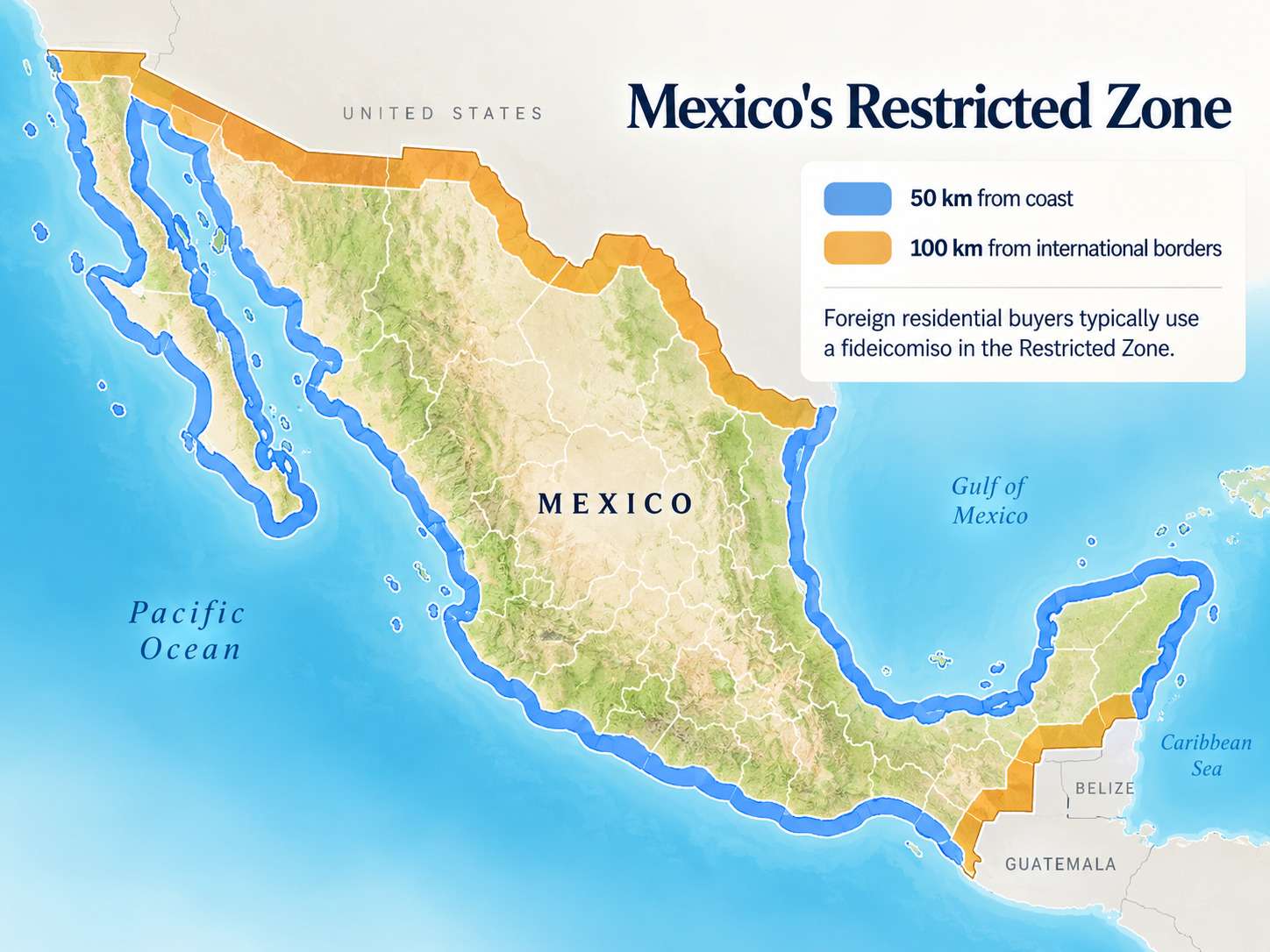
Mexico restricts direct foreign ownership of land located within 100 kilometres of an international border and 50 kilometres of the coastline. This area is known as the Restricted Zone. Residential property in this zone can still be acquired by Canadians, but it is held through a Mexican bank trust known as a fideicomiso.
Outside the Restricted Zone, Canadians can acquire property directly, subject to the Mexican legal requirements applicable to foreign purchasers. Mexico's Ministry of Foreign Affairs provides the official framework governing foreign ownership and Restricted Zone trusts.
For Canadian buyers, the important question is therefore not simply:
Can I buy property in Mexico?
The answer is yes.
The more important question is:
How do I make sure that the property, seller, purchase contract, ownership structure and closing are legally sound before I commit substantial money?
This guide explains the complete process from a Canadian buyer's perspective.
Key Takeaways
In This Guide
Can Canadians Legally Buy Property in Mexico?
Yes.
There is no general prohibition preventing a Canadian citizen from purchasing Mexican real estate.
What changes is how ownership must be structured, depending primarily on the location and intended use of the property.
Mexican law distinguishes between:
- property located inside the Restricted Zone, and
- property located outside the Restricted Zone.
For residential property within the Restricted Zone, foreign individual buyers use a fideicomiso established through an authorized Mexican financial institution.
Outside the Restricted Zone, foreigners can acquire property directly, subject to Mexico's constitutional and foreign-investment requirements.
The official legal framework is contained in Mexico's Foreign Investment Law and the procedures administered by the Ministry of Foreign Affairs.
For Canadians considering a purchase, MexLaw's real estate legal services for foreign buyers can assist from initial contract review through due diligence, closing and registration.
What Is Mexico's Restricted Zone?
The Restricted Zone consists of land located within:
The restriction originates in Article 27 of the Mexican Constitution.
Mexico's Ministry of Foreign Affairs confirms that foreigners cannot acquire direct ownership of land within these areas, but may use and enjoy qualifying residential property through a fideicomiso.
This matters particularly to Canadians because many of Mexico's most popular destinations fall within the Restricted Zone, including:
- Cancún;
- Playa del Carmen;
- Tulum;
- Cozumel;
- Puerto Vallarta;
- Riviera Nayarit;
- Mazatlán;
- Los Cabos; and
- many other coastal communities.
Being inside the Restricted Zone does not mean Canadians are prohibited from buying residential property.
It means that a different ownership structure is normally used.
What Is a Fideicomiso?
A fideicomiso is a Mexican bank trust used to allow foreign buyers to acquire beneficial rights over residential real estate within the Restricted Zone.
A Mexican financial institution acts as trustee and holds legal title to the property within the trust.
The Canadian buyer is named as the beneficiary.
The Ministry of Foreign Affairs specifically describes Restricted Zone fideicomisos as the legal mechanism through which foreigners may use and enjoy qualifying real property in these areas.
MexLaw provides a dedicated fideicomiso service for foreign property buyers to coordinate the trust structure, bank and Notario requirements.
Does the Bank Own Your Property?
Technically, the Mexican bank holds legal title in its capacity as trustee.
That does not mean the bank owns and controls the home in the ordinary commercial sense.
The property is held under the trust for the benefit of the foreign beneficiary.
Subject to the fideicomiso and applicable Mexican law, the beneficiary can generally exercise important rights associated with ownership, including the ability to:
- occupy the property;
- use it as a vacation home;
- rent it;
- receive income from it;
- improve it subject to applicable regulations;
- sell the beneficial interest;
- transfer applicable rights; and
- designate successor beneficiaries.
The fideicomiso should therefore not be confused with renting property from the bank.
How Long Does a Fideicomiso Last?
The Ministry of Foreign Affairs states that permits for Restricted Zone fideicomisos may be granted for a maximum period of 50 years.
The applicable legislation also allows the term to be extended.
Therefore, the commonly repeated idea that a Canadian automatically loses the property after 50 years is misleading.
The trust must be properly maintained and renewed according to the applicable legal and administrative procedures.
Can Canadians Buy Property Directly Outside the Restricted Zone?
Yes.
Outside the Restricted Zone, Canadians can generally acquire direct ownership of Mexican property.
However, it is an oversimplification to say that foreigners simply buy property outside the Restricted Zone “exactly like Mexicans.”
Foreign buyers remain subject to the applicable constitutional and foreign-investment requirements.
The appropriate legal structure should therefore be confirmed before the buyer signs a binding agreement or transfers substantial money.
Do Canadians Need Mexican Residency to Buy Property?
No.
Property ownership and immigration status are separate matters.
A Canadian does not need Temporary or Permanent Residency simply to purchase property in Mexico. Residency can, however, be helpful if you plan to make Mexico your home.
Likewise, owning property does not automatically give the purchaser unlimited permission to live in Mexico.
A Canadian planning to:
- retire in Mexico;
- spend extended periods there;
- work in Mexico;
- operate a business; or
- relocate permanently
should separately review immigration requirements.
MexLaw's Mexican immigration services can assist buyers whose property purchase is part of a broader relocation or retirement plan.
How to Buy Property in Mexico as a Canadian: Step by Step
The exact transaction varies according to the state, municipality, property type, ownership structure and whether the property is a resale or pre-construction purchase.
However, the following framework provides a useful overview.
Step 1: Identify the Property
The search may begin through:
- a real estate agent;
- developer;
- private seller;
- referral; or
- online property listing.
However, a property listing should not be treated as legal proof.
Marketing information does not by itself establish:
- ownership;
- title;
- absence of liens;
- legal boundaries;
- permitted land use;
- construction permits;
- short-term rental rights; or
- the seller's authority to complete the sale.
Legal due diligence determines whether you should buy it.
Step 2: Determine the Correct Foreign-Ownership Structure
Establish whether the property is inside or outside the Restricted Zone.
If it is residential property within the Restricted Zone, a fideicomiso is required for foreign individual buyers.
If it is outside the Restricted Zone, direct foreign ownership may be available subject to the applicable procedures.
The number of properties and intended use can also matter. If you are planning to acquire more than two properties as an investment, a Mexican corporation may be worth discussing as part of the ownership structure. MexLaw explains the distinction in Can Foreigners Buy Property in Mexico? Bank Trusts vs. Corporations.
This decision affects:
- closing documentation;
- SRE requirements;
- bank involvement;
- timing;
- closing expenses; and
- how the buyer's ownership rights are ultimately registered.
Step 3: Have the Offer or Purchase Agreement Reviewed Before Signing
Canadian buyers may encounter documents described as:
- offers;
- reservation agreements;
- promises to purchase;
- promissory agreements;
- purchase agreements;
- presale agreements; or
- sales contracts.
Do not assume that a document has no legal significance merely because it is called a “reservation.”
Before signing, the buyer should understand:
- the exact property being purchased;
- purchase price;
- currency;
- deposit;
- payment schedule;
- refund conditions;
- due-diligence period;
- closing deadline;
- seller obligations;
- buyer obligations;
- default provisions; and
- what happens if the transaction cannot legally close.
MexLaw provides dedicated real estate contract review services for foreign purchasers before they become contractually committed.
Step 4: Conduct Independent Legal Due Diligence
Once the commercial terms are acceptable, the property should undergo legal due diligence.
This should go considerably further than simply asking the seller whether the property has a clear title.
Depending on the transaction, due diligence can include verification of:
- registered ownership;
- seller identity;
- seller authority;
- title documentation;
- mortgages;
- liens;
- attachments;
- registered restrictions;
- cadastral records;
- property boundaries;
- tax obligations;
- water and municipal obligations;
- condominium obligations;
- land-use issues;
- permits;
- existing leases;
- fideicomiso documentation;
- agrarian or ejido issues; and
- developer documentation.
MexLaw's real estate due diligence service covers property ownership investigations, resales, presales, ejido land and other transactions where independent legal verification is required.
What Should Legal Due Diligence Include?
Confirm That the Seller Actually Owns the Property
The seller's identity should correspond with the legal ownership documentation.
If a corporation owns the property, verify:
- that the corporation legally owns it;
- that the company validly exists;
- who is authorized to act on its behalf; and
- whether the person signing has authority to complete the transaction.
If the seller is acting through a power of attorney, that authority should also be reviewed.
Review the Title and Registry Information
The registered legal description should correspond with the property being sold.
Important items can include:
- registered owner;
- legal description;
- surface area;
- lot or unit information;
- boundaries;
- registered limitations; and
- prior transfers.
Material inconsistencies should be investigated before closing.
Check for Liens and Encumbrances
A property may be subject to rights that affect the seller's ability to deliver clean title.
These can potentially include:
- mortgages;
- judicial attachments;
- usufruct rights;
- registered claims; or
- other encumbrances.
The existence of a mortgage does not necessarily make a purchase impossible.
It does mean that the closing must clearly establish how the obligation will be discharged.
Verify Taxes and Other Property Obligations
Outstanding obligations should be identified before closing.
Depending on the property, they can include:
- property taxes;
- municipal charges;
- water obligations;
- condominium fees; and
- special assessments.
Responsibility for outstanding amounts should be clearly established before the buyer takes title.
Buying a Condominium in Mexico
Many Canadians purchase condominiums in resort destinations.
A condominium buyer is not purchasing only the interior of the unit.
The property may also be subject to a condominium regime that governs:
- common areas;
- maintenance;
- owner responsibilities;
- monthly fees;
- special assessments;
- pets;
- renovations;
- permitted uses; and
- rental activity.
A Canadian purchasing with the intention of generating Airbnb or vacation-rental income should never assume short-term rentals are permitted simply because other units in the development appear online.
Condominium rules and applicable local regulations should both be verified.
Ejido Land: Important Considerations for Foreign Buyers
Mexico has forms of agrarian landholding, including ejido land, that operate differently from ordinary privately titled real estate.
A Canadian should not assume that:
Particular caution is warranted when a seller says:
- “the title is being processed”;
- “the ejido conversion is almost finished”;
- “everyone buys this way”;
- “you can build now and formalize the title later”; or
- “the community already approved everything.”
These statements should not replace documentary legal verification.
MexLaw has a dedicated ejido land legal service addressing foreign investment, land status, assembly resolutions and legal due diligence.
If agrarian history appears anywhere in the transaction, specialized review should occur before funds are committed.
BEFORE YOU SEND A DEPOSIT
Have the property, seller and purchase agreement independently reviewed before releasing substantial funds.
MexLaw can verify ownership, title, liens, property documentation and other legal risks before you become financially committed.
Request a Property ReviewBuying Pre-Construction Property in Mexico
Pre-construction property is particularly popular in:
- Riviera Maya;
- Tulum;
- Playa del Carmen;
- Puerto Vallarta;
- Riviera Nayarit;
- Cancún; and
- Los Cabos.
Potential advantages can include:
- early-stage pricing;
- preferred unit selection;
- payment plans; and
- potential appreciation during construction.
But the risks are different from purchasing a completed resale property.
With pre-construction, the buyer may be making substantial payments toward a property that:
- does not yet physically exist;
- is still under construction;
- does not yet have an individual title;
- depends on the developer completing the project; and
- may depend on future approvals, infrastructure or registration.
For this reason, the investigation should cover both the property and the developer.
Before signing a presale agreement, a Canadian buyer should understand:
- who owns the underlying land;
- which legal entity is developing the project;
- which company is signing the contract;
- whether that entity has legal authority to sell;
- relevant permits and approvals;
- whether liens or project financing exist;
- construction schedule;
- delivery deadline;
- unit specifications;
- payment schedule;
- delay provisions;
- cancellation rights;
- refund provisions;
- remedies for developer default; and
- how final title will ultimately be delivered.
MexLaw's pre-construction property legal service includes developer and property review, contract assistance, ongoing legal support during construction and closing coordination.
A Rendering Is Not a Contract
A development may be marketed with:
- pools;
- rooftop terraces;
- gyms;
- landscaping;
- ocean views;
- restaurants;
- furnishings; or
- other amenities.
What matters legally is whether material commitments are adequately reflected in the transaction documentation.
The same principle applies to advertised rental returns.
If a “guaranteed return” is material to the purchase, determine:
- who is guaranteeing it;
- whether the guarantee is contractual;
- how long it lasts;
- whether it is gross or net;
- which expenses are excluded; and
- what happens if the promised return is not paid.
BUYING PRE-CONSTRUCTION?
MexLaw can investigate the developer, property ownership, relevant documentation and purchase contract before you commit, and provide ongoing legal assistance through construction and closing.
Review a Presale PropertyDeposits and Escrow
Escrow and fideicomiso are entirely different concepts.
A fideicomiso deals primarily with the ownership structure.
Escrow is a mechanism for holding transaction funds until agreed contractual requirements have been satisfied.
MexLaw notes that Mexico does not have the same standardized escrow system commonly used in Canada and the United States.
Before sending a significant deposit, a Canadian buyer should know:
- who will receive the money;
- where it will be held;
- who controls the funds;
- what written escrow instructions apply;
- what conditions permit release;
- when amounts become non-refundable;
- what happens if due diligence fails;
- what happens if the transaction does not close; and
- how a dispute over the funds will be handled.
MexLaw offers escrow services for Mexican real estate transactions involving defined release conditions and separately administered accounts.
Independently Verify Wiring Instructions
International real-estate transactions can be targets for payment fraud.
If wiring instructions suddenly change, independently verify the information through a trusted communication channel before transferring funds.
This applies even if the email appears to come from:
- a lawyer;
- developer;
- broker;
- Notario;
- bank; or
- closing representative.
For a substantial real-estate purchase, independent verification of bank instructions is an important safeguard.
What Does the Notario Público Do?
The role of a Mexican Notario Público is substantially different from what most Canadians associate with a notary public.
The Mexican Notario performs important official legal functions in the formalization of property transactions.
Depending on the transaction, the Notario can be involved in:
- preparation of the public deed;
- review of closing documents;
- applicable certificates;
- formalization of signatures;
- calculation or collection of certain taxes and government charges; and
- registration procedures.
If There Is a Notario, Why Does the Buyer Need a Lawyer?
Because the roles are different.
The Notario performs the official functions required to formalize the transaction.
The Canadian purchaser's independent lawyer represents the buyer's interests.
Independent counsel can assist before the Notario closing stage with:
- offer review;
- contract review;
- title investigation;
- due diligence;
- developer investigation;
- escrow;
- fideicomiso coordination;
- negotiation;
- resolution of legal issues; and
- review of closing documentation.
The two roles are complementary rather than interchangeable.
MexLaw's real estate closing services coordinate due diligence, documentation, Notario involvement and registration through completion of the transaction.
How Much Does It Cost to Buy Property in Mexico?
There is no single closing-cost percentage that accurately applies to every Mexican property purchase.
Costs can vary according to:
- state;
- municipality;
- property value;
- assessed value;
- ownership structure;
- fideicomiso requirements;
- trustee bank;
- Notario;
- registry charges;
- appraisal;
- certificates;
- legal services; and
- transaction-specific complications.
A generic statement that “closing costs are always X%” can therefore be misleading.
Possible buyer-side costs can include the following.
Property Acquisition Tax
Real-estate acquisitions can be subject to an acquisition tax calculated according to the rules of the applicable jurisdiction.
Notario and Closing Costs
Formalization of the transaction involves Notario costs and other closing expenses.
Public Registry Charges
The completed acquisition must be properly processed through the relevant property-registration system.
Appraisal and Valuation Costs
A valuation may be required as part of the transaction and tax process.
Certificates and Administrative Costs
The closing may require documentation concerning:
- title;
- registered encumbrances;
- property taxes;
- cadastral information; and
- other state or municipal requirements.
What Does a Fideicomiso Cost?
Fideicomiso costs vary depending on the trustee bank and the transaction. As a general estimate, initial setup costs can be around USD $2,804, although the final amount should always be confirmed for the specific purchase.
Buyers should also plan for:
- trustee-bank setup or acceptance charges;
- annual trustee administration fees; and
- applicable Notario, legal and registration expenses.
Because bank fees and transaction costs vary, MexLaw can provide a transaction-specific estimate before closing.
Consider the Total Cost of Ownership
The purchase price is not the only cost associated with owning Mexican property.
Ongoing expenses can potentially include:
- property tax;
- fideicomiso administration;
- condominium fees;
- insurance;
- utilities;
- property management;
- repairs;
- maintenance;
- rental commissions; and
- tax and accounting requirements where income is generated.
These expenses should be considered when evaluating the long-term affordability and investment potential of the property.
Mexican and Cross-Border Tax Considerations
Owning property in Mexico can create tax obligations in Mexico, particularly if the property is rented or later sold.
Property ownership, immigration status and tax residency are separate matters. Simply buying a home in Mexico does not by itself determine tax residency.
Tax treatment can become complex when an owner has obligations in more than one country. There are mechanisms that may help reduce or avoid double taxation, but the analysis depends on the owner's circumstances.
MexLaw recommends obtaining advice from a qualified Mexican accountant and, where applicable, a tax professional in the owner's country of residence.
Can Canadians Rent Their Mexican Property?
Potentially, yes.
However, the ability to own a property should not be confused with unlimited permission to operate it as a short-term rental.
Before relying on rental income, consider:
- Mexican income-tax requirements;
- VAT where applicable;
- state or local lodging taxes;
- condominium restrictions;
- short-term-rental rules;
- digital-platform requirements;
- property-management arrangements; and
- tax obligations in the owner's country of residence, where applicable.
Tax Considerations for Rental Income
Rental income from Mexican property can create Mexican tax and reporting obligations. Depending on the rental structure, other taxes or registrations may also apply.
Owners may also have tax obligations in their country of residence. Because cross-border tax rules can be complex and mechanisms may be available to reduce or avoid double taxation, owners should consult a qualified accountant regarding their specific circumstances.
What Happens When a Canadian Sells Mexican Property?
A future sale can create Mexican tax obligations. The tax treatment depends on the property, ownership structure, seller's circumstances and transaction details.
For this reason, the owner should keep important property records from the original acquisition onward.
These can include:
- acquisition deed;
- fideicomiso documentation;
- original closing statement;
- acquisition-tax records;
- Notario invoices;
- registration charges;
- legal fees; and
- properly documented capital improvements.
Do not assume these records will be easy to reconstruct many years after purchase. Owners who also have tax obligations outside Mexico should consult a qualified adviser in their country of residence.
Inheritance, Successor Beneficiaries and a Mexican Will
A fideicomiso can provide for successor beneficiaries, helping establish who succeeds to the beneficial rights in the property after the original beneficiary's death.
However, the fideicomiso applies only to the property held in that trust. It does not automatically govern other Mexican assets a Canadian may acquire, such as a vehicle, bank account or other property.
For that reason, a Mexican will can be an important part of estate planning for foreign property owners, particularly when they own assets in Mexico beyond the fideicomiso. Any Mexican will should be coordinated with Canadian wills or other estate documents so the overall plan is consistent.
MexLaw can assist foreign owners with Mexican will and estate planning services in Mexico.
Can Canadians Buy Through a Mexican Corporation?
Yes, in appropriate situations.
However, a corporation should not automatically be presented as a simple substitute for a fideicomiso.
Mexican companies with foreign participation can directly acquire Restricted Zone property for qualifying non-residential activities under Mexico's Foreign Investment Law.
Residential Restricted Zone property is treated differently.
A corporation can potentially be appropriate for situations involving:
- commercial property;
- hospitality businesses;
- development projects;
- operating businesses; or
- certain multi-property investment structures.
But incorporating can also create:
- corporate-maintenance obligations;
- accounting;
- bookkeeping;
- tax filings;
- banking requirements; and
- ongoing tax and reporting obligations.
A Canadian purchasing a vacation condominium should therefore not create a company merely because somebody says it is cheaper than maintaining a fideicomiso.
The ownership structure should reflect the property's actual use, whether it is primarily personal or investment property, the number of properties being acquired, and the owner's wider legal and tax circumstances.
Can Canadians Buy Mexican Property Without Being There?
In many cases, yes.
A properly prepared power of attorney can allow a representative in Mexico to perform specified acts on the buyer's behalf.
Depending on the transaction, the authority might include:
- signing documentation;
- working with the Notario Público;
- dealing with the trustee bank;
- completing fideicomiso documentation; or
- attending closing.
The scope should be carefully drafted.
A transaction-specific or special power of attorney may offer greater protection than granting unnecessarily broad authority.
Apostille Requirements for Canadian Documents
Canada joined the Hague Apostille Convention effective January 11, 2024.
MexLaw summarized the resulting changes to Canadian document authentication in its 2024 article, Navigating Changes in Canadian Document Authentication Services.
A Canadian power of attorney intended for Mexican use may need to be:
- appropriately drafted;
- notarized where required;
- apostilled in Canada; and
- translated into Spanish for Mexican use.
The Mexican lawyer or Notario should confirm the required wording before the buyer signs the Canadian document.
Can Canadians Get a Mortgage in Mexico?
Potentially, but traditional Mexican mortgage financing can be difficult for non-resident Canadian buyers.
Availability varies by lender and can depend on residency or immigration status, income, credit profile, the property and loan-to-value requirements.
Some developers offer financing directly, particularly for pre-construction or presale properties. These arrangements can provide an alternative when traditional bank financing is not available.
Other possible approaches can include cash, seller financing, Canadian home-equity borrowing or borrowing secured by other Canadian assets.
Financing should be confirmed before signing a purchase agreement that depends on it.
Important Information About Developer Financing
Developer financing is most commonly seen in pre-construction or presale projects, where the financing arrangement is tied directly to the purchase.
Common payment structures can include:
- reservation deposit;
- initial payment;
- monthly or quarterly instalments;
- construction-stage payments; and
- balance at delivery.
These arrangements can be convenient, but the purchaser may be advancing substantial funds before receiving completed title.
That increases the importance of:
- developer due diligence;
- contract review;
- refund provisions;
- construction obligations; and
- remedies if the development does not proceed as expected.
Currency Risk for Canadian Buyers
A Canadian buyer may think about the property in Canadian dollars while the transaction is denominated in:
- Mexican pesos;
- U.S. dollars; or
- another agreed currency.
If payments are spread over months or years, exchange-rate movements can materially affect the Canadian-dollar cost.
This can influence:
- deposit;
- construction payments;
- closing balance;
- annual fideicomiso charges;
- condominium fees;
- taxes; and
- future proceeds on resale.
The purchase agreement should clearly identify the contractual currency and any applicable conversion mechanism.
Common Mistakes Canadians Make When Buying Property in Mexico
1. Assuming the Real Estate Agent Is the Buyer's Legal Adviser
An experienced agent can be very helpful in identifying and negotiating a property.
Legal representation is a separate function.
2. Signing Before Getting Independent Legal Review
The time to review contractual obligations is before signing.
Not after a deposit becomes non-refundable.
3. Sending Money Before Understanding the Refund Conditions
Before transferring funds, establish:
- who receives them;
- who controls them;
- when they can be released; and
- under what circumstances they can be returned.
4. Assuming the Notario Represents the Buyer
The Notario performs essential official functions.
Independent buyer representation is different.
5. Treating Pre-Construction Marketing as a Legal Guarantee
Renderings and sales presentations are marketing.
The purchase agreement and supporting legal documentation establish the buyer's contractual rights.
6. Buying Ejido Land Without Understanding Its Current Legal Status
Promises about future title conversion should not substitute for current documentary verification.
7. Assuming a Mexican Corporation Is Always Better Than a Fideicomiso
A corporation can introduce ongoing corporate, accounting and tax obligations.
The proper structure depends on the intended use of the property.
8. Overlooking Mexican Tax Obligations
Rental income, ownership and a future sale can create Mexican tax obligations. Buyers and owners should obtain advice from a qualified Mexican accountant when applicable.
9. Focusing Only on the Purchase Price
The true cost of ownership can also include:
- condominium fees;
- fideicomiso charges;
- insurance;
- taxes;
- maintenance;
- management;
- utilities; and
- repairs.
Warning Signs That Deserve Additional Investigation
None of the following automatically proves that something is wrong.
Each should, however, prompt additional verification.
“You Don't Need a Lawyer.”
Independent legal review should not be treated as an obstacle to a legitimate transaction.
“You Need to Send the Money Today.”
A competitive property market does not eliminate the need for due diligence.
“We'll Fix the Title Later.”
The buyer should understand what legally transferable title exists now.
“The Contract Is Standard, So There Is Nothing to Review.”
A standard contract is still a legal contract.
“Everyone Here Rents on Airbnb.”
That does not establish that the particular property legally permits the intended rental activity.
“The Rental Return Is Guaranteed.”
Ask who is making the guarantee, where it is documented and what happens if payments stop.
“The Notario Checks Everything, So You Don't Need Due Diligence.”
The Notario's official function should not be confused with independent buyer representation.
“We've Never Had a Problem Before.”
A previous successful transaction does not establish the legal status of the property being purchased today.
15 Questions to Ask Before Sending a Deposit
Before releasing substantial funds, a Canadian buyer should try to obtain clear answers to the following:
- Who is the registered owner of the property?
- Has the seller's authority to sell been verified?
- Has the registered title been reviewed?
- Are there mortgages, liens or other encumbrances?
- Has the property's legal status and ownership history been reviewed?
- Is the property inside the Restricted Zone?
- Will a fideicomiso be required?
- Has the purchase agreement been independently reviewed?
- Where will the deposit be held?
- When can the deposit be released?
- Under what circumstances can it be refunded?
- Are relevant permits and approvals in place?
- If it is pre-construction, has the developer and underlying land been investigated?
- What are the estimated closing and ongoing ownership costs?
- Who is independently representing my legal interests?
Frequently Asked Questions
Can Canadians buy property in Mexico?
Yes.
Canadians can legally acquire real estate throughout Mexico.
The ownership structure depends primarily on whether the property is inside or outside the Restricted Zone.
Can Canadians buy beachfront property in Mexico?
Yes.
Because beachfront property falls within 50 kilometres of the coastline, qualifying residential property will generally be within the Restricted Zone.
A Canadian buyer commonly acquires the beneficial property rights through a fideicomiso.
Do Canadians need residency to buy property in Mexico?
No.
Mexican property ownership and immigration status are separate matters.
Does buying property give me Mexican residency?
No.
Owning property does not automatically provide Temporary or Permanent Residency.
Property ownership can, however, be relevant to certain immigration circumstances, and buyers planning to relocate should obtain separate immigration advice.
What is a fideicomiso?
A fideicomiso is a Mexican bank trust used to allow foreign beneficiaries to acquire rights over residential property in Mexico's Restricted Zone.
Does the bank really own my house?
The bank holds legal title as trustee under the fideicomiso.
The property is held for the beneficiary rather than for the bank's own use.
What happens after 50 years?
Mexican law permits fideicomisos to be extended.
The Canadian owner does not simply lose the property at the end of the initial 50-year term.
Can I sell property held through a fideicomiso?
Yes.
The sale structure will depend on the existing trust, purchaser and circumstances of the transaction.
Can my children inherit my Mexican property?
A fideicomiso can provide for successor beneficiaries.
The arrangement should nevertheless be coordinated with the owner's broader Canadian and Mexican estate planning.
Can I buy property in Mexico without travelling there?
Often, yes.
A properly drafted power of attorney can allow a representative to perform specified acts on behalf of the Canadian purchaser.
Can I buy through a Mexican corporation?
Potentially.
A corporation can be appropriate for certain commercial structures, but it is not automatically the best choice for an individual purchasing a residential vacation home.
Can I rent the property on Airbnb?
Potentially.
However, ownership alone does not guarantee short-term-rental rights.
Condominium restrictions, local rules and tax requirements should be investigated before the buyer relies on projected rental revenue.
What tax obligations apply if I rent the property?
Rental income from Mexican property can create Mexican tax and reporting obligations. Owners may also have obligations in their country of tax residence.
Because cross-border tax rules can be complex and mechanisms may be available to reduce or avoid double taxation, owners should consult a qualified accountant regarding their specific circumstances.
Are there taxes when I sell?
Potentially. A sale of Mexican real estate can create Mexican tax obligations, and the amount depends on the property, ownership structure, seller's circumstances and transaction details.
Owners who also have tax obligations in another country should consult a qualified adviser in that jurisdiction.
Can Canadians obtain mortgages in Mexico?
Potentially, depending on the lender and the purchaser's circumstances.
Non-resident Canadian buyers should investigate financing eligibility before signing a transaction that depends on mortgage financing.
Is buying pre-construction property in Mexico safe?
It can be successfully done, but it requires greater due diligence because the buyer may make substantial payments before the completed property and final title exist.
Developer, land, permits, contract, payment protections and buyer remedies should all be investigated.
Is escrow required?
MexLaw Escrow provides a secure and structured mechanism for holding and releasing transaction funds according to agreed-upon conditions, helping protect the interests of the parties involved in a real estate transaction in Mexico.
What Is the Most Important Rule When Buying Mexican Property?
Verify first. Pay second.
Before releasing substantial non-refundable funds, confirm:
- ownership;
- seller authority;
- title;
- liens;
- property status;
- purchase contract;
- ownership structure; and
- how the buyer's money will be protected.
Can Canadians Safely Buy Property in Mexico?
Yes.
Mexico has well-established legal mechanisms through which foreign purchasers can acquire property both inside and outside the Restricted Zone.
The important issue is not whether Canadians are permitted to buy.
They are.
The critical issue is whether the specific transaction is properly structured and independently verified before the purchaser becomes financially committed.
A properly managed purchase should establish:
- valid ownership;
- transferable title;
- appropriate due diligence;
- the correct foreign-ownership structure;
- a clear purchase agreement;
- controlled handling of transaction funds;
- compliance with applicable requirements;
- proper Notario formalization; and
- completion of registration.
How MexLaw Helps Canadian Property Buyers
MexLaw provides independent legal representation for Canadians and other foreign purchasers acquiring real estate throughout Mexico.
Depending on the transaction, assistance can include:
MexLaw's real-estate practice is designed specifically for foreign purchasers who need the Mexican legal process explained and coordinated from the beginning of the transaction through closing and registration.
Already Found a Property in Mexico?
The best time to have a Mexican real-estate transaction reviewed is before signing a binding purchase agreement or transferring a substantial deposit.
MexLaw can review the proposed transaction, investigate the property, identify potential legal risks and help establish the appropriate ownership and closing structure.
Request a Free Consultation

